
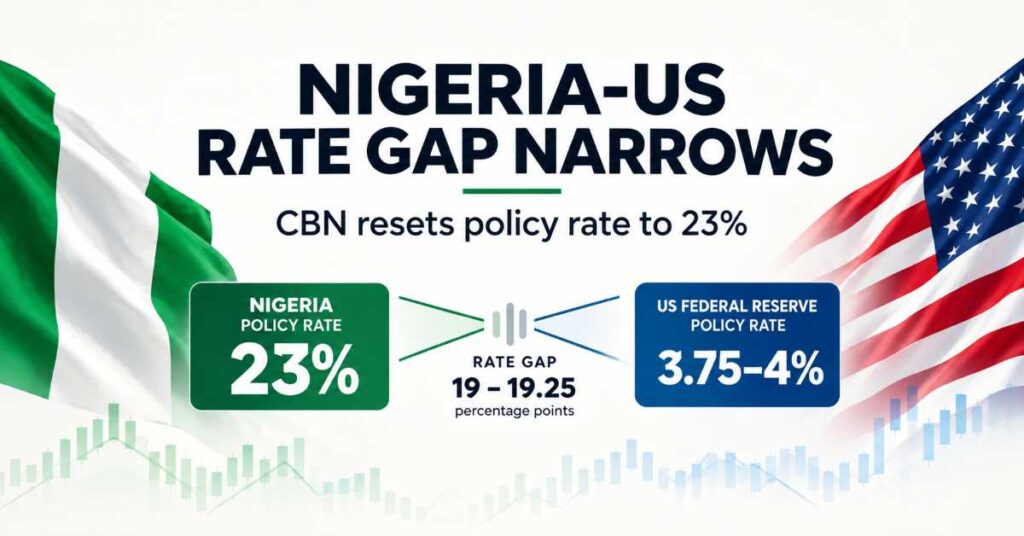
Nigeria’s interest-rate advantage over the United States has narrowed sharply after the Central Bank of Nigeria (CBN) reset its benchmark rate to 23 per cent while the US Federal Reserve raised its policy range to 3.75–4 per cent.
The shift has reduced the nominal gap between the two policy rates to about 19–19.25 percentage points, from roughly 22.5–22.75 percentage points previously. The change is drawing attention to the attractiveness of Nigerian naira-denominated assets and the potential implications for foreign capital flows.
The CBN cut its Monetary Policy Rate by 350 basis points at its September 21–22 Monetary Policy Committee meeting, taking it from 26.5 per cent to 23 per cent. It also recalibrated its Standing Facilities Corridor to +50/-300 basis points around the MPR while leaving banks’ cash reserve requirements unchanged.
The Federal Reserve, meanwhile, raised its federal funds target range by 25 basis points to 3.75–4 per cent in September, its first rate increase since 2023. The move put US monetary policy on a different path from Nigeria’s latest adjustment.
That divergence matters because the large yield premium on Nigerian assets has been one of the factors considered by international investors when assessing naira-denominated securities. A smaller differential could reduce the relative attraction of Nigerian fixed-income investments, particularly if domestic market yields also decline.
However, the CBN has pushed back against describing its decision as a conventional easing cycle. Governor Olayemi Cardoso said the September decision was intended to improve the transmission of monetary policy and strengthen the role of the MPR as the central policy signal. The bank said its restrictive stance remains in place.
The central bank’s decision came against improving domestic indicators. Nigeria’s external reserves had risen above $55 billion by September, while the current-account surplus increased to $7.54 billion in the second quarter of 2026. The CBN said stronger external-sector conditions and reduced foreign-exchange pressures provided greater room to reset the monetary framework.
For the government, lower domestic interest rates could eventually reduce the cost of borrowing as Treasury and bond yields adjust. For businesses, the bigger question is whether the change will translate into lower lending rates rather than simply lower benchmark rates.
Banks have already begun adjusting some lending and deposit rates following the CBN decision, but the transmission is unlikely to be immediate or uniform across the financial system. The CBN’s liquidity framework and banks’ funding costs will influence how much of the policy adjustment reaches borrowers.
The narrowing rate gap therefore creates a new balancing act for Nigerian policymakers. The CBN has more room to support economic activity as inflation and external pressures improve, but it must also preserve the conditions that have helped stabilise the naira and attract foreign capital.
For investors, the key issue will be whether Nigeria can maintain its improving macroeconomic fundamentals while domestic yields gradually decline. The outcome could determine how attractive Nigerian assets remain relative to opportunities in the United States and other major markets.