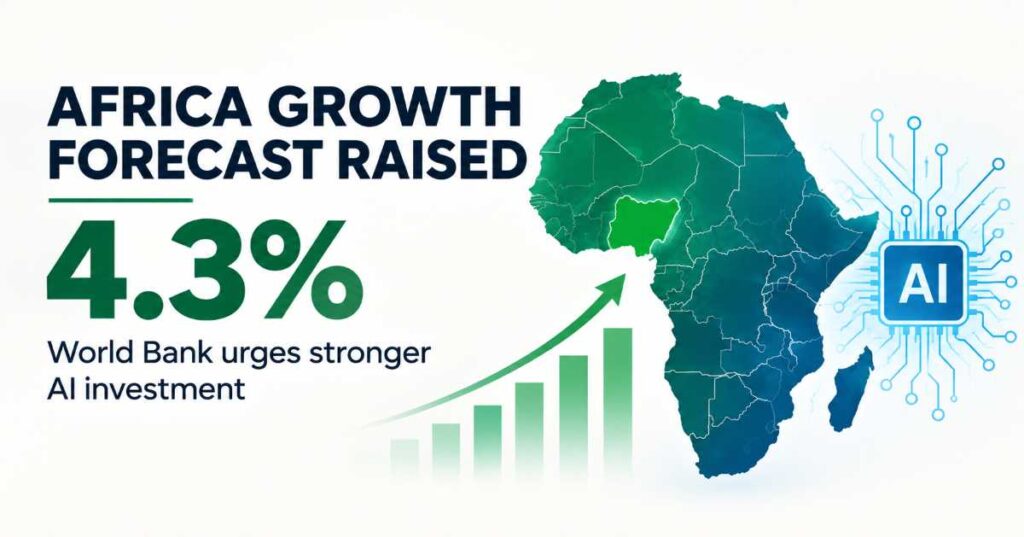
The World Bank has raised its 2026 growth forecast for Sub-Saharan Africa to 4.3 per cent from 4.1 per cent, citing stronger economic performance across the region while urging governments to invest more aggressively in artificial intelligence to improve productivity and create jobs.
The revised forecast was contained in the World Bank’s October 2026 Africa Economic Update released on Tuesday. The bank said growth forecasts had been upgraded for nearly three-quarters of the region’s economies.
Nigeria is among the countries receiving an upgrade. The World Bank now expects the Nigerian economy to grow by 4.3 per cent in 2026, up from 4.0 per cent in 2025, before expanding by 4.4 per cent annually in 2027 and 2028. The bank linked the stronger outlook to improving macroeconomic stability, stronger investor confidence and a gradual recovery in private investment.
The upgrade comes despite a difficult external environment. The World Bank pointed to higher energy prices and disruptions linked to the conflict in the Middle East, while also warning that high interest rates in advanced economies and elevated debt-servicing costs continue to weigh on African economies.
The improvement in headline growth, however, has not translated into a comparable increase in living standards. The World Bank estimates that per-capita income growth in the region will reach only 1.8 per cent in 2026, up from 1.6 per cent in 2025, leaving a significant gap between economic expansion and the gains experienced by individuals and households.
That gap is one reason the bank is placing greater emphasis on artificial intelligence. Andrew Dabalen, the World Bank’s chief economist for Africa, said governments should focus on AI investments that can raise productivity and create employment rather than treating the technology simply as a feature of advanced economies.
The bank’s argument is that Africa does not need to replicate the huge AI infrastructure investments being made in the United States and other major economies to benefit from the technology. More affordable applications could be deployed in areas such as education, agriculture and small-business management, including tools that support student learning, help farmers identify livestock diseases and automate accounting tasks.
But wider adoption will require more than access to AI software. The World Bank has highlighted the need for shared data centres, stronger data-protection frameworks, better connectivity, reliable electricity and greater investment in digital and technical skills. These constraints remain particularly important for African businesses operating in markets where infrastructure costs can limit the adoption of new technologies.
For Nigeria, the message comes as the country’s own growth outlook improves. The economy expanded by 4.43 per cent year-on-year in the second quarter of 2026, while the World Bank expects stronger private investment and improving macroeconomic stability to support further expansion.
The broader challenge is turning that improvement into more productive businesses and better-paying jobs. For African economies, the World Bank’s latest outlook suggests that maintaining growth will increasingly depend not only on macroeconomic reforms but also on how effectively businesses and governments use technologies such as AI to raise productivity.
For Nigerian businesses in particular, that creates an opportunity as well as a policy challenge. AI adoption could help companies reduce costs, improve decision-making and reach customers more efficiently, but the benefits will depend on whether the country’s infrastructure, skills and regulatory environment can keep pace with the technology.