

Starting a business can appear straightforward from the outside. Find a product or service people want, attract customers, collect payments and grow. The reality is more complicated. A business can have regular customers and still struggle financially. A product can be excellent but priced incorrectly. A hardworking owner can remain overwhelmed because every decision depends on them.
Many of the most important lessons every entrepreneur learns the hard way emerge from situations that could have been prevented with better planning, clearer financial records or a more realistic understanding of customers.
For entrepreneurs in Nigeria, the consequences can be particularly visible when electricity, transportation, exchange rates, supplier prices and other operating conditions change. Yet the underlying lessons apply to businesses almost everywhere.
The goal is not to eliminate every mistake. Experimentation inevitably involves uncertainty. It is to recognise avoidable risks, learn quickly from experience and prevent one bad decision from becoming a threat to the entire business.
Here are ten lessons that can help entrepreneurs build more resilient, financially sustainable businesses.
1. Sales Do Not Automatically Mean Profit
One of the earliest mistakes entrepreneurs make is treating money received from customers as money they have earned.
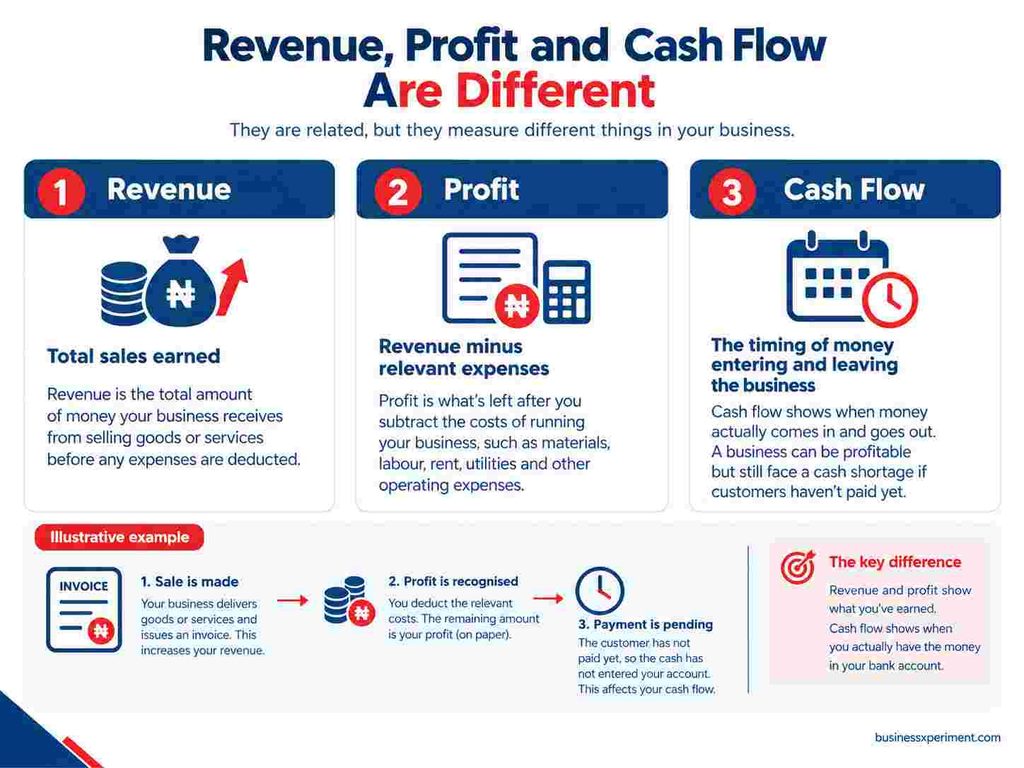
A business may generate impressive sales and still struggle to pay suppliers, staff, rent and other bills. Sales measure revenue, not the amount left after expenses. Even accounting profit does not necessarily mean cash is available when payments fall due.
Consider a small business that records ₦500,000 in monthly sales.
| Item | Illustrative amount |
| Monthly sales | ₦500,000 |
| Materials and direct service costs | ₦180,000 |
| Rent, utilities and transport | ₦100,000 |
| Staff costs | ₦100,000 |
| Marketing and other operating expenses | ₦40,000 |
| Remaining operating profit before other charges | ₦80,000 |
The business has ₦500,000 in sales, but only ₦80,000 remains under these assumptions. The figure is not necessarily the owner’s take-home income: taxes, financing costs, depreciation, reinvestment and other expenses may still affect the final result.
The example also assumes the sales have been collected. If customers owe the business money, the actual cash available could be lower. This distinction matters because entrepreneurs often make spending decisions based on revenue rather than what the business can afford.
What to do instead
Maintain separate records for sales, expenses, outstanding customer payments and available cash. Review them regularly rather than waiting until bills become difficult to pay.
Calculate the profit on individual products or services where possible. A popular offering may generate substantial revenue while contributing very little after its direct costs.
A business becomes financially stronger when its owner understands what each sale contributes, not merely how much money enters the business.
2. Cash Flow Can Matter More Immediately Than Profit
Profitability and cash flow are related, but they answer different questions. Profitability asks whether the business earns more than it spends over a given period. Cash flow asks when money enters and leaves the business. That timing difference can create serious problems.
Imagine a small supplier that delivers ₦700,000 worth of goods to customers who have 30-day payment terms. The supplier must pay ₦450,000 to purchase or produce those goods immediately, alongside other operating expenses.
The sale may be profitable on paper, but the supplier cannot use the unpaid invoice to settle an electricity bill or pay a worker today. The reverse can also happen. A business may receive advance payments and have plenty of cash temporarily while still operating at a loss because its costs exceed the revenue it ultimately earns.
In Nigeria, where supplier prices and operating costs may change between orders, delayed payments can make an already narrow cash position more difficult to manage.
Build a simple cash-flow routine
- Record expected customer payments and their due dates.
- List upcoming expenses, including rent, salaries, supplier bills and debt repayments.
- Estimate the cash available after essential commitments.
- Follow up on overdue invoices and agree on payment terms before accepting large orders.
- Maintain a reserve for disruptions where the business can reasonably afford one.
For businesses that routinely wait for customer payments, deposits or staged payments may reduce the amount of working capital tied up in each job. However, payment terms must be commercially reasonable. Demanding full advance payment in a market where customers expect credit could cost the business legitimate opportunities.
Do not commit money simply because a sale has been agreed. Understand when the cash will actually be available.
3. Customers’ Actual Behaviour Matters More Than Their Compliments
Entrepreneurs can become emotionally attached to their ideas. Friends may praise a product, social media followers may express interest, and potential customers may promise to buy later. These responses can be encouraging, but they are not reliable proof of demand.
A business needs evidence that customers are willing and able to pay, use the offering and return when they need it again.
For example, someone planning a laundry service might hear frequent complaints about unreliable laundry providers. That suggests a possible opportunity, but it does not establish whether enough people in the target neighbourhood will pay the proposed price.
The entrepreneur still needs to investigate customer preferences, collection and delivery expectations, acceptable turnaround times, competing providers and willingness to pay. A small trial with real paying customers can reveal more than weeks of informal praise.
Testing customer demand is an important part of turning an idea into a viable business. For a broader look at the journey from identifying a customer problem to building a sustainable operation, explore the five stages of building a real business.
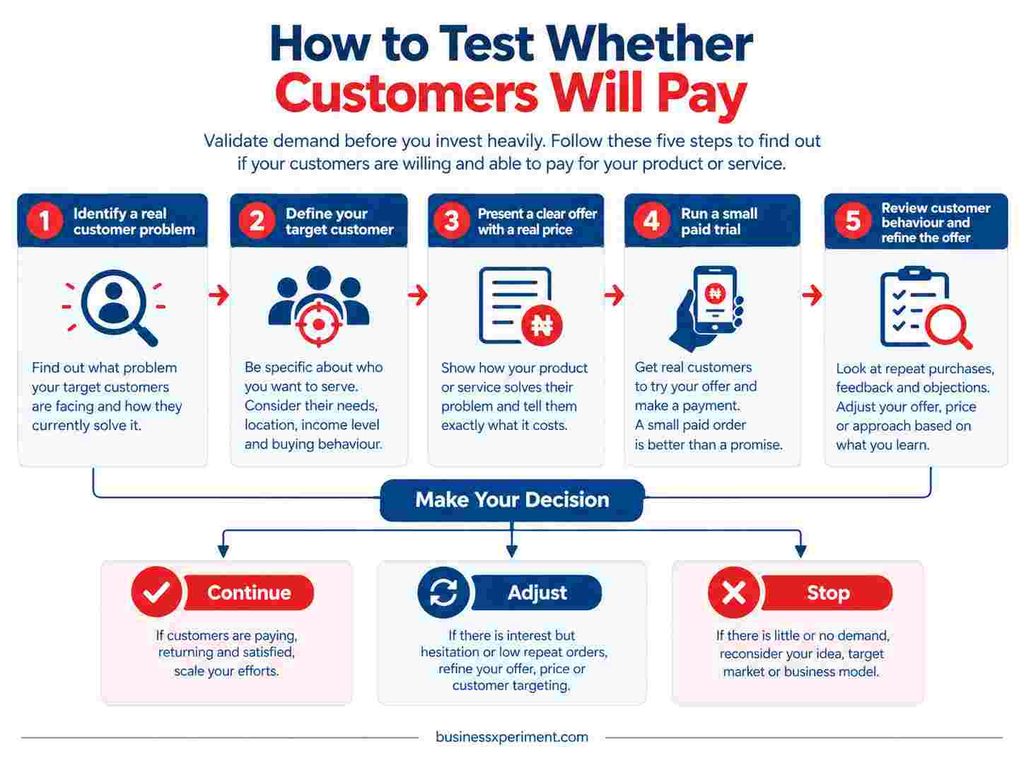
How to test demand before investing heavily
- Identify a specific customer group rather than trying to serve everyone.
- Ask about the problem customers currently experience and how they solve it.
- Present a clear offer with a real price.
- Seek paid trial orders or another meaningful commitment.
- Record objections, repeat purchases and reasons customers decline.
- Adjust the offer before committing to major equipment, inventory or premises.
Be careful not to treat one successful sale as proof of a sustainable market. Early buyers may be unusually enthusiastic or may have needs that are not representative of the wider market.
Listen to what customers say, but make important investment decisions using evidence of what they actually do.
4. Underpricing Can Make a Busy Business Unsustainable
Many entrepreneurs set prices by looking at competitors, estimating what customers can afford or choosing a figure that feels easy to sell. The problem is that a competitor’s price may reflect a different cost structure, purchasing power, operating scale or business model. Copying it does not guarantee that the price will work for you.
Underpricing can also create a misleading sense of success. Orders increase, the owner works longer hours, and revenue rises, but the business generates too little money to replace equipment, pay the owner properly or absorb unexpected expenses.
Suppose a service costs ₦6,000 per job to deliver, including the relevant direct costs. If the customer pays ₦7,000, the contribution is ₦1,000 per job before fixed costs and other expenses.
If the price rises to ₦8,000 while the direct cost remains ₦6,000, the contribution becomes ₦2,000. The business now earns twice the contribution per job, although the final profit still depends on overheads and demand at the new price.
This is an illustration, not a recommendation to increase prices without testing customer response.
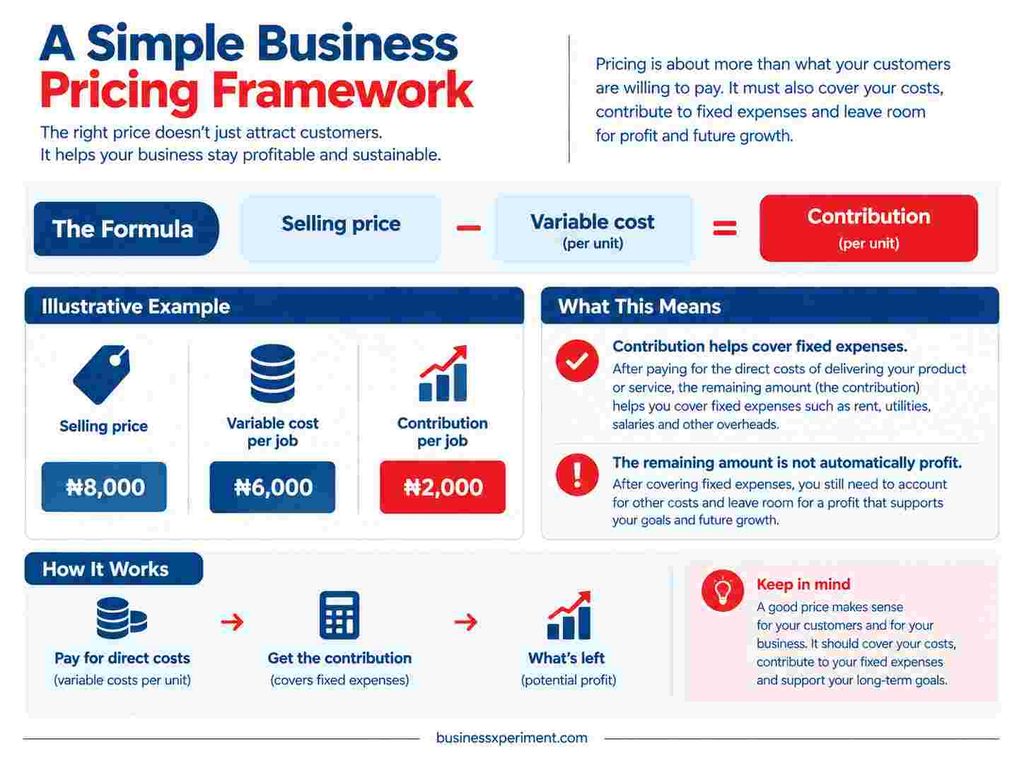
Price for sustainability, not just sales
Calculate direct costs, allocate a reasonable share of overheads, and determine the contribution each sale makes toward covering fixed expenses and generating profit.
Then assess the price against customer value, competing offers and demand. If the price customers will accept is consistently below the cost of delivering the product or service sustainably, reconsider the offering, process, target market or business model.
Do not assume that higher volume will automatically solve a weak margin. Selling more units at an inadequate contribution can increase workload and cash requirements without fixing the underlying problem.
A good price must make sense for the customer and for the business that has to deliver the promise.
5. Hard Work Cannot Permanently Compensate for a Weak System
Entrepreneurship often requires long hours, especially in the early stages. The owner may handle sales, purchasing, customer complaints, bookkeeping, delivery and daily operations. That flexibility can help a new business get started. It becomes a constraint when the business cannot function properly without the owner’s constant presence.
Consider a small retail shop where only the owner knows the supplier contacts, current prices, customer credit balances and stock levels. If the owner becomes unavailable, even routine decisions may stop.
The problem is not necessarily a lack of effort. It is that essential knowledge and responsibilities have not been organised into a repeatable system.
Turn repeated work into a process
Document tasks that happen regularly, such as:
- Opening and closing procedures.
- Customer order recording and payment confirmation.
- Stock checks and supplier reordering.
- Quality control and handling complaints.
- Daily sales reconciliation.
- Staff responsibilities and escalation procedures.
A process does not need expensive software. A consistent notebook, spreadsheet or simple digital record can be enough for a small operation.
Start with the activities where mistakes are costly or where the owner spends too much time answering the same questions. Improve the process gradually instead of trying to formalise everything at once.
Systems also make it easier to identify the source of a problem. If an order is delayed, the business can examine the relevant stage rather than relying on guesswork.
Hard work helps you operate a business; reliable systems help you operate it consistently.
6. Not Every Customer Is Worth Keeping
Entrepreneurs often assume that losing a customer is always a setback. In reality, some customer relationships cost more than they contribute.
A customer may negotiate every price, repeatedly delay payment, demand work outside the agreed scope or require so much attention that other profitable orders suffer. That does not mean every demanding customer should be rejected. Some high-value clients need additional service, and an occasional complaint can reveal a genuine weakness in the business.
The important distinction is between a customer who requires reasonable attention and a relationship that repeatedly destroys value.
Evaluate the full cost of serving a customer
Look beyond the invoice amount. Consider the time spent communicating, special delivery arrangements, rework, discounts, payment delays and the likelihood of repeat business.
A customer who places a ₦100,000 order is not necessarily more valuable than one who places a ₦40,000 order. The smaller order may produce a better margin, require less work and be paid immediately.
Entrepreneurs can improve difficult relationships by setting clear terms, defining the scope of work, confirming deadlines and communicating payment expectations before an agreement is finalised. When a relationship remains consistently unprofitable despite reasonable attempts to improve it, declining future work may be the more responsible decision.
Build a customer base around sustainable value and fair relationships, not sales volume alone.
7. Hiring the Wrong Person Can Cost More Than Delaying a Hire
As a business grows, the owner may reach a point where doing everything alone becomes impractical. Hiring can free up time and improve capacity, but it also introduces costs, management responsibilities and the risk of mistakes.
A common error is hiring simply because the owner feels overwhelmed without first identifying which tasks need to be delegated.
Another is selecting a worker based entirely on familiarity or personal trust rather than the skills and reliability required for the role.
For a small business, a poor hiring decision can lead to wasted materials, missed orders, dissatisfied customers and additional supervision. But refusing to hire when capacity is clearly insufficient can also limit growth.
Make the decision based on the work
Before recruiting, identify the tasks consuming the most time and determine which can be handled by someone else.
Estimate the full employment cost, including wages, applicable statutory obligations, training, tools and supervision. Compare that cost with the value of the additional capacity and the work the owner can undertake with the time released.
Use clear responsibilities, practical assessments and a reasonable probation or review process where appropriate. Explain expected standards and how performance will be evaluated.
If demand is irregular, temporary help, a contractor or outsourcing may be more suitable than immediately taking on a permanent employee, provided the arrangement is lawful and appropriate to the work. Once someone is hired, provide training and feedback. Delegation without clear instructions simply transfers confusion from the owner to the worker.
Hire to solve a defined capacity problem, and create the conditions that allow the person to succeed.
8. Mixing Personal and Business Money Hides the Truth
For many sole proprietors, especially in the early stages, personal and business finances overlap. Money received from customers may pay household expenses, while personal funds cover business shortfalls.
The immediate problem is not that an owner receives money from a business. Owners need to earn a living. The problem is failing to record those withdrawals and distinguish them from operating expenses.
When the records are unclear, an entrepreneur may believe the business is underperforming when personal withdrawals are the main source of cash pressure. Alternatively, the owner may mistake money needed for suppliers and upcoming bills for disposable income.
Establish basic financial discipline
Use a dedicated business account where practical and appropriate, and record every transaction, including owner withdrawals and additional personal contributions.
Set a realistic withdrawal arrangement based on the business’s cash position rather than taking money whenever the account balance looks healthy.
Review financial performance at least monthly. Track sales, expenses, outstanding payments, debts, cash reserves and the amount withdrawn by the owner.
Keep supporting invoices and receipts, and maintain records required for applicable legal and tax obligations. In Nigeria, business registration and tax responsibilities depend on the structure and activities of the enterprise. Consult the relevant official authorities or a qualified adviser rather than relying on assumptions about what applies to every small business.
Separating finances does not automatically make a business profitable, but it makes its actual condition easier to understand.
You cannot manage what you cannot measure, and unclear financial records make even simple decisions harder.
9. Growth Can Expose Problems Instead of Solving Them
Entrepreneurs naturally want more customers, higher sales and a larger operation. Yet expansion increases the demands placed on cash, people, equipment, suppliers and management. Understanding the factors that separate growing businesses from stagnant ones can help entrepreneurs recognise why sustainable growth requires more than increasing sales.
A business that can comfortably serve 20 customers may struggle with 100 if it has not developed the capacity to handle the additional work.
More sales can require more inventory before customers pay. A larger premises can increase fixed expenses. Additional staff can create training and supervision demands. A new location can introduce unfamiliar customer behaviour and operating conditions.
Growth is valuable when the business can support it. Expansion undertaken without understanding its costs can weaken an otherwise healthy operation.
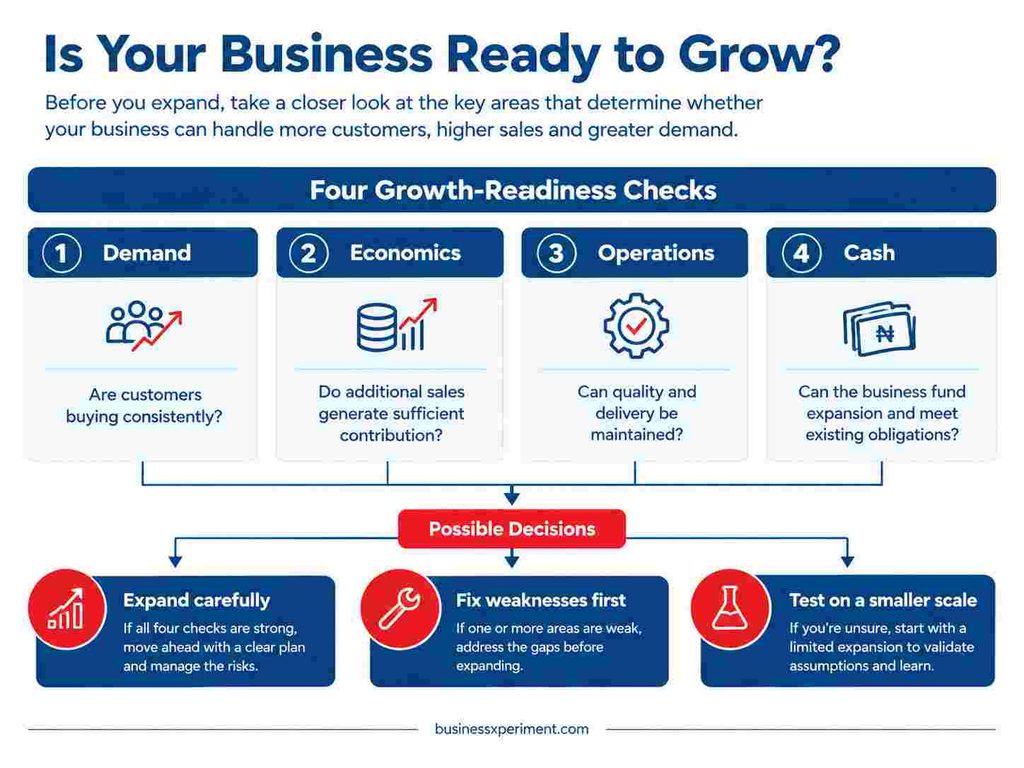
Test whether the business is ready to grow
Before expanding, examine four areas:
- Demand: Is customer demand consistent enough to justify the additional capacity?
- Economics: Will the extra sales contribute enough to cover their direct costs and additional overheads?
- Operations: Can the business maintain quality, delivery times and customer service at the higher volume?
- Cash: Can it finance the expansion without compromising essential obligations?
A controlled experiment is often safer than a large commitment. A business considering a second outlet, for example, might test demand through a temporary arrangement, delivery service or limited operating period before signing a long lease.
The appropriate test depends on the business model, but the principle remains the same: validate the assumptions behind expansion before making the commitment difficult to reverse.
Growth should strengthen the business, not simply make it bigger.
10. Waiting for the Perfect Time Can Become an Expensive Mistake
Some entrepreneurs delay starting because they want more money, a better location, a perfect product, an impressive website or complete certainty about the market. These delays can prevent promising ideas from becoming real businesses. Understanding why promising business ideas fail to become real businesses can help entrepreneurs recognise when preparation has become an obstacle to action.
Preparation matters, particularly when mistakes could create serious financial or legal consequences. But preparation becomes counterproductive when it replaces the small experiments that would produce useful evidence.
A person considering a food business, for example, may spend months designing packaging and comparing equipment without testing whether customers will buy the proposed menu at a sustainable price.
The alternative is not reckless action. It is to distinguish between decisions that must be settled before launch and decisions that can be improved after the first real-world test.
Start with a controlled experiment
Define the problem, the customer group and the smallest credible version of the offer. For entrepreneurs exploring lower-cost ways to get started, digital business opportunities that do not require a large budget can provide ideas for testing demand before committing substantial resources. Set a budget you can afford to lose, establish a clear test period and decide what evidence would justify continuing.
For instance, a service provider might aim to secure ten paying trial customers within a defined period. That is an illustrative experiment, not a universal benchmark. The right target depends on the market, the price, the sales cycle and the resources available.
Measure what happens. Did customers pay? What objections emerged? How much time did delivery require? Were customers satisfied? Did the economics work?
If the results are weak, adjust the offer or reconsider the idea before investing more. If the results are promising, expand the test carefully. The key is to make mistakes small enough to learn from them without putting the entire business at risk.
You do not need certainty before you begin. You need a disciplined way to test your assumptions and respond to evidence.
How to Apply These Lessons to Your Business
Knowing these lessons is useful, but the real value comes from applying them to the decisions you make every week.
Start with a practical business review.
First, examine your finances. Calculate the contribution your main products or services generate, list outstanding customer payments and identify the bills due over the next month.
Second, speak to customers. Find out why they buy, what frustrates them and what would make them return. Use actual purchases and repeat business to test whether demand is sustainable.
Third, identify one operational weakness. It might be unreliable delivery, poor stock records, excessive dependence on the owner or repeated customer complaints. Document the problem and introduce a manageable improvement.
Fourth, review your capacity before expanding. Estimate the extra costs, working capital, staffing and operational changes a proposed expansion would require.
Finally, choose one assumption to test. Set a limited budget, define what success would look like and review the evidence before committing additional resources.
A simple monthly review can help you distinguish between problems that require immediate action and issues that can be addressed gradually. You do not need a sophisticated management system to begin; consistency and accurate records matter more than complexity.
Final Thoughts
The lessons every entrepreneur learns the hard way are rarely about working harder or believing more strongly in an idea. They are about understanding how a business actually functions when customers, money, people and operating conditions interact.
Sales must translate into sustainable returns. Cash must arrive when obligations fall due. Customers must value the offer enough to pay for it. Employees need clear expectations, and growth must be supported by adequate systems and resources.
Mistakes will still happen. Some assumptions will prove wrong, customers will leave, costs will change and plans will need revision. What matters is whether the entrepreneur recognises the warning signs early enough to respond.
The most useful habit is to review the evidence before making the next major decision. Ask what the numbers show, what customers are doing, where resources are being wasted and which assumption needs testing.
A successful business is not one that never makes mistakes. It is one that learns from them, adapts its decisions and becomes better equipped to survive the next challenge.
Sources and Further Reading
1. Corporate Affairs Commission (CAC) — Business Name Registration https://cac.gov.ng/services/business-name/ Official guidance on registering a business name and completing the registration process.
2. Corporate Affairs Commission — Company Registration https://www.cac.gov.ng/services/company-registration Official information about company registration and the required process.
3. Nigeria Revenue Service — Tax Laws https://www.nrs.gov.ng/tax-laws/nrs-act Official access to Nigeria’s tax legislation, including the Nigeria Tax Act 2025 and Nigeria Tax Administration Act 2025. Entrepreneurs should verify which requirements apply to their business and consult a qualified tax professional when necessary.