
Almost every business begins with an idea. Someone notices a problem, identifies an opportunity, develops a product, or discovers a service people might need. The idea can be exciting enough to inspire months of planning and conversations about what the business could become.
But an idea is not a business. Neither is a business plan, a social media page, a registered business name, or a product sitting in a shop waiting for customers.
A real business begins to take shape when an entrepreneur identifies a genuine customer need, develops a solution people are willing to pay for, and establishes a practical way to deliver that solution while managing costs. Building something that generates income consistently requires additional work: finding customers, understanding the numbers, improving operations, and creating a model that can survive beyond the owner’s initial enthusiasm.
This distinction matters, particularly for first-time entrepreneurs. It is possible to spend money on equipment, rent, branding, inventory, and advertising before discovering that customers are unwilling to pay enough to sustain the business. It is also possible to spend months planning without ever testing whether the idea has commercial potential.
The process becomes more manageable when business development is treated as a series of stages, each with its own objectives, risks, and decisions.
In this article, we will examine five broad stages most entrepreneurs need to navigate from identifying a problem to building a sustainable operation. They are not rigid rules, and businesses do not always move through them in a straight line. However, understanding them can help founders make better decisions, avoid unnecessary spending, and focus on what matters most at each point in the journey.
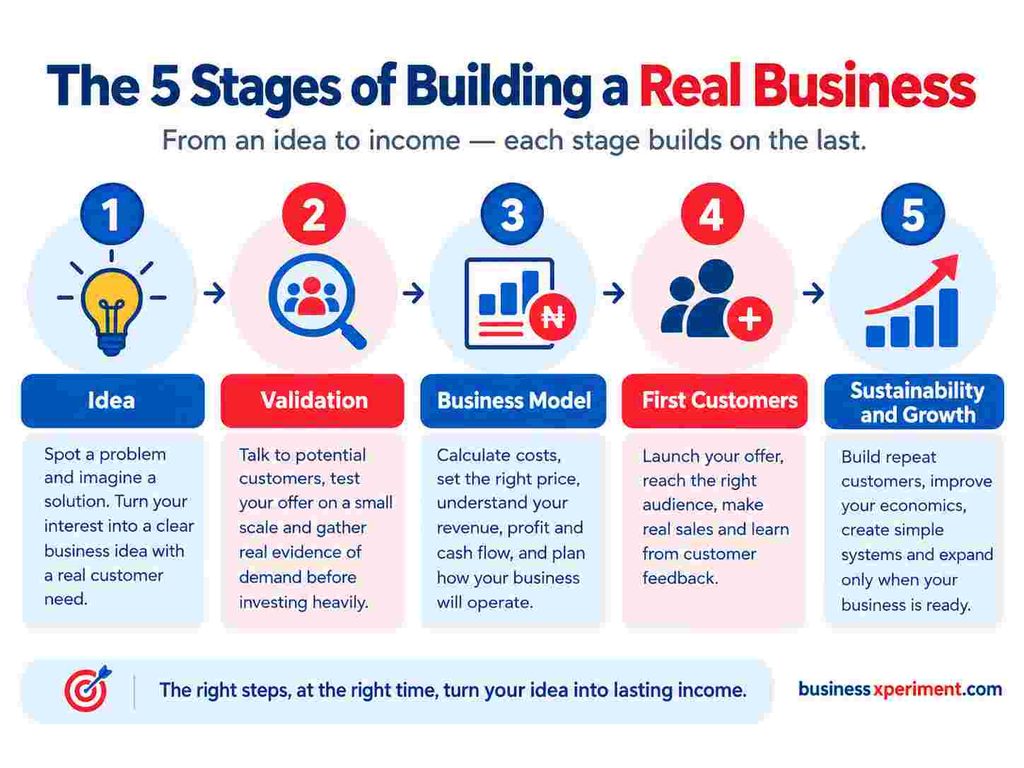
Stage 1: Turn an Idea Into a Real Customer Problem
Every business idea needs a starting point, but the strongest starting point is not necessarily a product or a personal passion. It is a problem that people genuinely want solved.
An aspiring entrepreneur might want to open a restaurant, launch a clothing brand, provide digital marketing services, or start a delivery company. These are possible business ideas, but none automatically represents a viable opportunity.
The important question is why customers would choose to pay for the proposed product or service.
Consider someone who wants to establish a laundry service in a busy part of Lagos. The initial idea might be to wash and iron clothes for people who have limited time. That sounds reasonable, but it leaves several questions unanswered.
Are enough people in the area dissatisfied with their current laundry options? Do they prefer doorstep collection or dropping clothes off themselves? Are they concerned about turnaround time, fabric care, convenience, or price? Would they pay for a new provider rather than continue using an existing one?
These questions help transform a general idea into a more specific business opportunity.
Start by understanding the customer
A useful first step is to identify the people who experience the problem most clearly. Trying to serve everyone can make it difficult to develop an offer that appeals strongly to anyone.
A prospective business owner should establish:
- Who is most likely to need the solution?
- What problem are these customers trying to solve?
- How do they currently deal with it?
- What frustrates them about existing alternatives?
- How important is the problem, and are they willing to pay to address it?
The answers do not need to come from expensive research. Conversations with potential customers, observations of existing businesses, and a review of competitors can provide useful initial evidence.
The U.S. Small Business Administration’s guide to market research and competitive analysis explains how research can help entrepreneurs understand customers, demand, and competitors. Although its guidance is US-focused, the underlying principles apply broadly.
Separate personal enthusiasm from market demand
Enjoying an activity can be a useful starting advantage. Someone who enjoys cooking may have relevant skills for a food business, while a person with writing experience may be able to offer content services.
However, personal interest does not establish that the opportunity is commercially viable.
A business also needs customers, a competitive offer, workable costs, and a delivery process. An entrepreneur may be skilled at making a product but discover that the market will not support the price required to produce it profitably.
The objective of Stage 1 is to define a specific customer problem and identify a plausible group of people who may pay for a solution.
Before spending significant money, write a simple statement describing the customer, the problem, and the proposed solution. If the problem cannot be explained clearly, more investigation may be needed.
Stage 2: Validate the Idea Before Investing Heavily
Once a potential problem has been identified, the next step is to establish whether the proposed solution has genuine demand.
This is where many entrepreneurs make an expensive mistake. They assume that because friends like an idea, people have expressed interest online, or competitors appear successful, their own business will attract paying customers.
Interest is not the same as a purchase. Compliments do not pay operating expenses, and a competitor’s existence does not guarantee that another business can enter the market profitably.
Validation means gathering evidence before committing substantial resources.
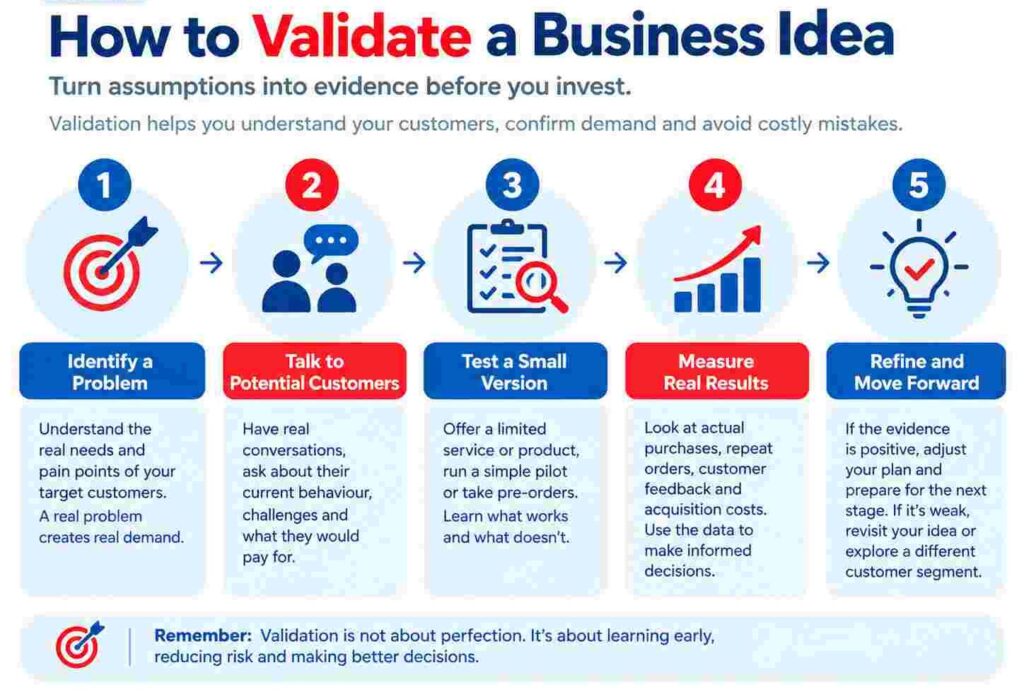
Talk to potential customers
Speak with people who fit the intended customer profile. Ask about their current behaviour and experiences rather than simply asking whether they like the idea.
For example, instead of asking someone whether they would use a proposed laundry service, ask how they currently get their clothes washed, how often they pay for laundry, what problems they encounter, and what they would improve about their current arrangement.
Questions about actual behaviour often reveal more than hypothetical promises.
Look for repeated patterns. If several potential customers independently describe the same problem, that may justify further testing. If their needs differ significantly from your assumptions, the business idea may need to change.
Test the smallest practical version
Entrepreneurs do not always need a full shop, extensive inventory, expensive equipment, or a polished website to begin testing an idea.
Depending on the business, a small test might involve:
- Offering a limited number of services to an initial group of customers.
- Producing a small batch before committing to larger inventory.
- Creating a sample or demonstration of a proposed product.
- Taking legitimate pre-orders with clear terms and realistic delivery commitments.
- Providing a service manually before investing in automation or additional staff.
The purpose is not to make the business appear bigger than it is. It is to learn whether the proposed solution works and whether customers will pay for it.
A small experiment can reveal practical issues that market research alone may miss. Customers might like the product but find it inconvenient to purchase. They might accept the advertised price but expect delivery that makes the service too expensive to operate.
Define what successful validation looks like
There is no universal number of customers that proves an idea will succeed. The appropriate evidence depends on the product, market, price, and cost structure.
Nevertheless, entrepreneurs should decide in advance what they need to learn from a test.
Useful indicators include actual purchases, repeat orders, customer feedback, the cost of acquiring customers, and the difference between the selling price and the cost of delivering the offer.
A few purchases may demonstrate initial interest, but they do not necessarily establish sustainable demand. Equally, a weak first test does not always mean the idea is worthless. The offer, pricing, target market, or delivery method may need adjustment.
The objective of Stage 2 is to replace assumptions with evidence before making larger commitments.
If the evidence is weak, revise the idea or investigate a different customer segment. If the evidence is promising, move forward with a clearer understanding of what the business needs to deliver.
Stage 3: Build a Business Model That Can Make Money
An idea can solve a real problem and attract customers without becoming a profitable business.
The missing link is often the business model: the way the business creates value, reaches customers, earns revenue, and manages the costs involved in delivering its products or services.
Before launching at a larger scale, an entrepreneur needs to understand how money will move through the business.
Calculate the cost of delivering the offer
Start by identifying the costs associated with running the business. These may include rent, equipment, inventory, transportation, electricity, fuel, packaging, software, payment processing, labour, repairs, taxes, and marketing.
Some costs remain relatively stable over a period, while others increase with each sale. Many businesses also face mixed costs that contain both fixed and variable elements.
A laundry operator, for instance, might incur monthly rent and certain equipment expenses while also paying for detergent, water, packaging, transport, electricity, and additional labour as order volume changes.
Ignoring these expenses can produce a misleading picture of profitability.
It is also important to distinguish startup costs from ongoing operating costs. Buying equipment may require a substantial initial payment, while maintaining it creates continuing expenses. Both affect the business, but they need to be planned for differently.
Set a price that supports the business
Pricing should reflect more than what competitors charge or what customers say they prefer to pay.
A sustainable price must consider the value offered, customer expectations, competitive alternatives, the cost of fulfilling each sale, and the business’s share of ongoing expenses.
Imagine a service provider charging ₦5,000 for a job that costs ₦3,200 in direct expenses. The difference is ₦1,800 before accounting for other business costs.
That difference is not automatically the owner’s profit. It must also contribute towards expenses such as rent, administration, equipment maintenance, and other overheads.
If the price is too low, the business may attract customers while struggling to cover its obligations. If it is too high relative to the value customers perceive, sales may remain weak.
The objective is to find a price that customers will accept and that gives the business a reasonable path to financial sustainability.
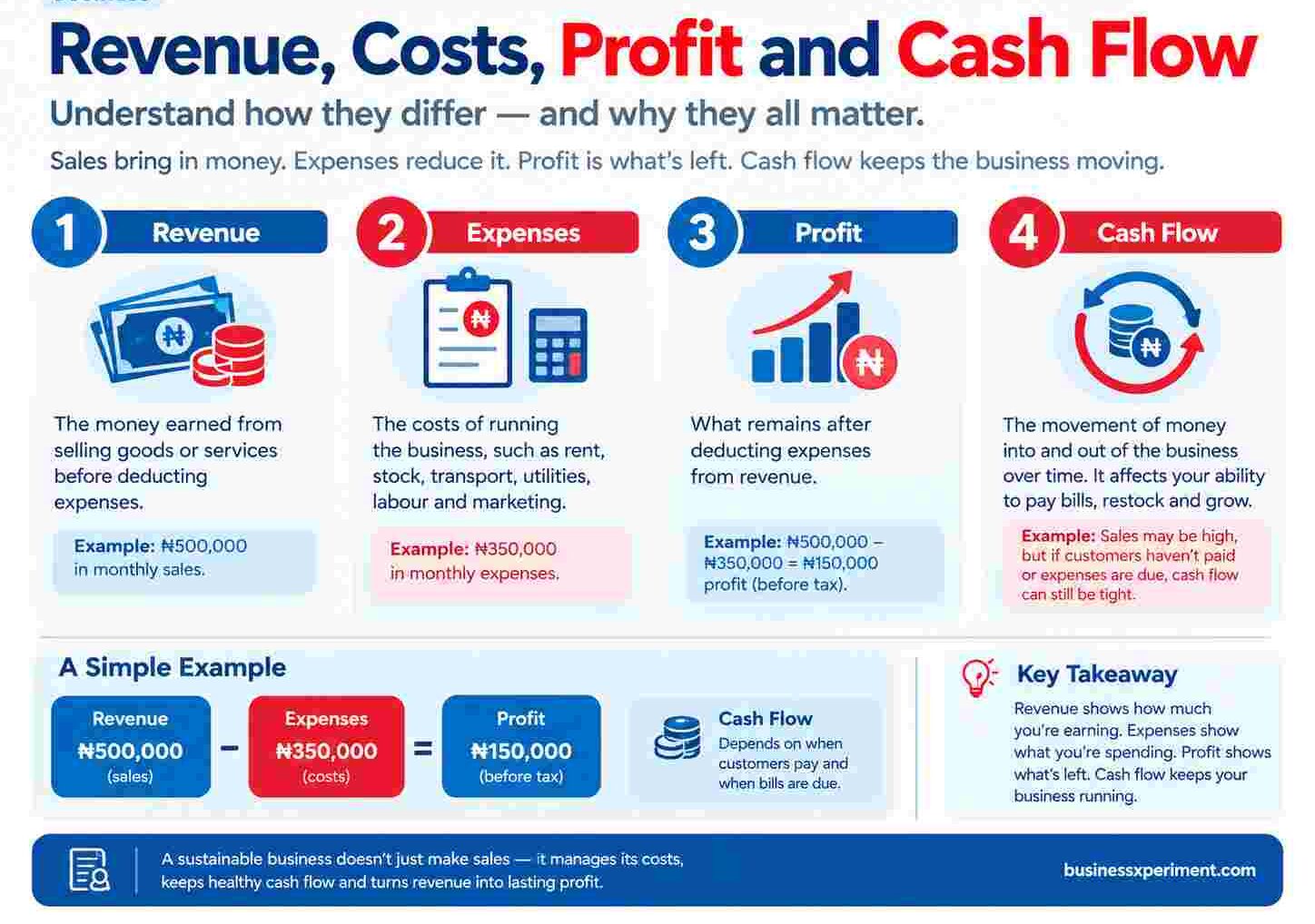
Understand revenue, profit, and cash flow
These three concepts are related, but they are not interchangeable.
Revenue is the money earned from selling goods or services before deducting expenses.
Profit is what remains after the relevant expenses are deducted.
Cash flow concerns the movement of money into and out of the business over time. A business may record sales but still struggle to pay bills if customers have not paid, expenses fall due earlier, or too much cash is tied up in inventory.
Consider a business that records ₦500,000 in monthly sales. That figure alone cannot establish whether the business is doing well. The owner must also understand its expenses, payment timing, outstanding debts, and the amount of money available to meet upcoming obligations.
A useful next step is to estimate the break-even point: the level of sales at which total revenue equals total costs.
For a simple business selling one product or service, the break-even quantity can be estimated by dividing fixed costs by the contribution earned per sale. Contribution per sale is the selling price minus the variable cost per unit.
The Small Business Administration’s break-even guidance provides further explanation of this calculation.
Decide how the business will operate
The business model should also clarify how customers will find the business, how orders will be fulfilled, how payments will be collected, and what resources are required to deliver the promised value.
Some businesses can begin from home or operate online. Others require a physical location, specialist equipment, inventory, permits, or qualified personnel.
In Nigeria, entrepreneurs should also investigate the legal and regulatory requirements that apply to their particular activities. Where business registration is appropriate or required, the Corporate Affairs Commission provides information about business-name registration and the relevant process.
The objective of Stage 3 is to establish a workable commercial model, not merely to produce an attractive business plan.
An entrepreneur should be able to explain who pays, what they pay for, how much it costs to deliver the offer, and what needs to happen for the business to cover its expenses.
Stage 4: Launch, Find Paying Customers, and Learn From Sales
After establishing that an idea has potential and developing a workable model, the business can move into the market.
This stage is about turning preparation into actual transactions. The entrepreneur must attract customers, deliver the product or service, collect payment, and determine whether the business can meet expectations consistently.
A launch does not need to be elaborate. In many cases, a focused launch is more useful than spending heavily on branding, decoration, equipment, or advertising before demand has been established.
Start with a clear offer
Customers should understand what the business provides, who it serves, how much it costs, and how to buy it.
A vague offer makes purchasing decisions more difficult. A specific offer gives potential customers a clearer reason to engage.
For example, a new laundry business could initially focus on reliable washing and ironing for working professionals in a defined neighbourhood. That is a more practical starting point than attempting to serve every possible customer with every possible service.
The offer can expand as the business gathers evidence about customer demand and operational capacity.
Choose realistic ways to reach customers
Customer acquisition depends on the nature of the business and where its potential buyers look for solutions.
A neighbourhood service might depend on local visibility, referrals, partnerships, and direct relationships with nearby customers. An online service may use search engines, professional networks, social media, targeted outreach, or referrals.
The important question is not which marketing channel is most popular. It is which channel reaches the intended customers at a cost the business can sustain.
Entrepreneurs should also avoid confusing visibility with commercial results. Social media followers, website visits, and enquiries can be useful indicators, but they do not replace paying customers.
Track the path from initial interest to completed sales. This helps reveal whether the main challenge is attracting attention, converting enquiries, pricing the offer, or delivering a satisfactory experience.
Deliver what was promised
The first customers provide an opportunity to test the complete business process.
Can the business deliver on time? Is the quality consistent? Are the prices sufficient to cover the actual work involved? Do customers understand the terms? Are complaints handled effectively?
These questions matter because customer acquisition is only one part of building a business. A company that attracts buyers but fails to deliver reliably can damage its reputation and lose opportunities for repeat sales.
Feedback should be recorded and assessed rather than accepted uncritically. One customer’s preference may not represent the entire market, but repeated complaints can reveal a problem that needs attention.
Keep records from the beginning
Record sales, expenses, payments received, money owed, stock levels where relevant, and customer orders.
Even a small operation can benefit from a simple spreadsheet or bookkeeping system. Good records help owners identify profitable products, monitor cash shortages, compare marketing channels, and make decisions using evidence rather than memory.
The objective of Stage 4 is to establish that the business can attract real customers and deliver its offer in practice.
Early sales are an important milestone, but they are the beginning of the learning process, not proof that the business is already sustainable.
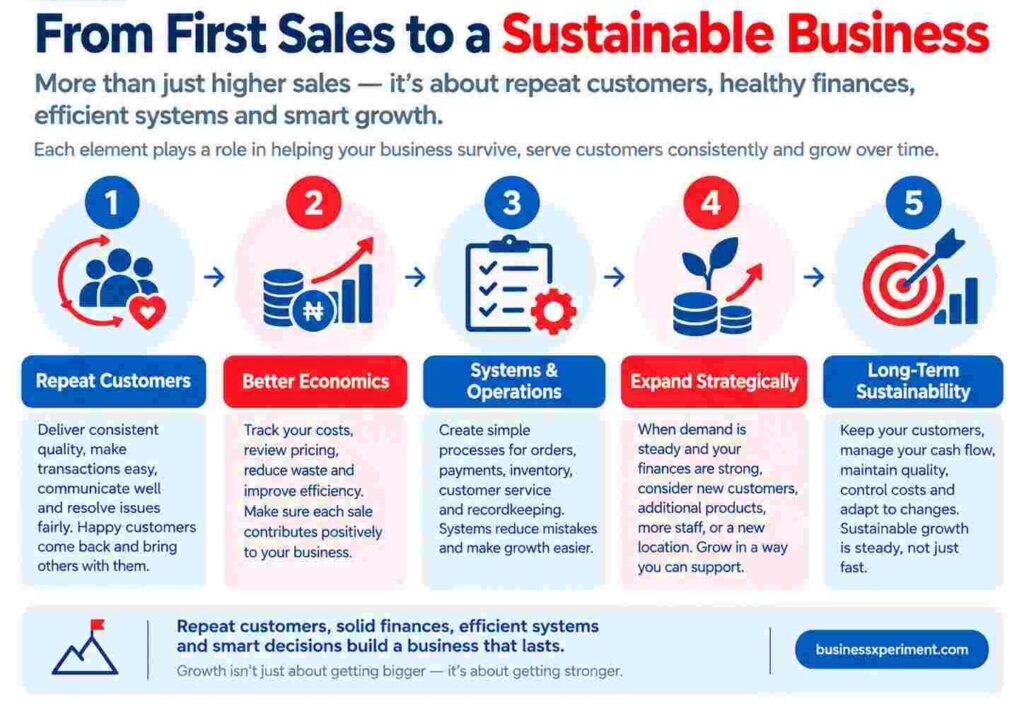
Stage 5: Turn Early Sales Into a Sustainable Business
A business that has made its first sales has demonstrated something important: at least some customers are willing to pay for its offer.
The next challenge is to make that activity repeatable and financially sustainable.
This requires more than increasing sales. The owner must understand which activities create value, which costs are becoming difficult to manage, and what needs to change as the operation becomes more demanding.
Build repeat business
Depending on the product or service, repeat customers can provide a more predictable foundation than constantly searching for new buyers.
Businesses can encourage repeat purchases by delivering consistent quality, communicating clearly, making transactions convenient, and resolving problems fairly.
A laundry service might improve collection arrangements and turnaround times. A consultant might establish a clear project process and maintain relationships with previous clients. A retailer might monitor which products customers buy regularly and ensure that popular items remain available.
Repeat business is not automatic. It must be earned through a reliable customer experience and an offer that continues to meet a genuine need.
Improve the economics of each sale
As sales increase, business owners should monitor whether each additional transaction contributes positively to the operation.
Higher sales can sometimes create greater pressure rather than greater financial security. More orders may require additional staff, inventory, transport, equipment, or working capital.
A business can become busier without becoming more profitable if costs rise faster than the value generated.
Review pricing, supplier arrangements, waste, delivery expenses, staffing, and the time required to complete each order. The aim is to improve the relationship between the resources used and the value delivered without damaging quality.
Create systems that reduce dependence on memory
In the earliest stage, an owner may personally handle sales, customer communication, production, payments, and recordkeeping. As activity grows, this arrangement can become difficult to maintain.
Basic operating procedures help make work more consistent. These might cover how orders are received, how quality is checked, how customer complaints are handled, how payments are recorded, and when supplies should be replenished.
Systems do not have to be complicated. A checklist, a standard order form, a written pricing guide, or a regular financial review can prevent avoidable mistakes.
The purpose is to make the business easier to manage, not to introduce unnecessary administration.
Expand only when the business is ready
Growth can take several forms: reaching new customers, introducing another product, hiring staff, entering a new location, investing in equipment, or improving an existing service.
However, expansion introduces new costs and risks. A second location may require rent and additional supervision. Hiring employees creates recurring obligations. Buying more inventory ties up cash that might be needed for other expenses.
Before expanding, examine whether demand is sufficiently established, the current operation is performing reliably, the finances can support the commitment, and the business can maintain quality at a larger scale.
In some cases, improving an existing operation is more valuable than expanding it.
The objective of Stage 5 is to build a business that can serve customers consistently, manage its finances responsibly, and grow without creating avoidable instability.
Sustainable growth is not necessarily rapid growth. It is growth the business can support.
Common Mistakes That Keep Businesses Stuck
Although each business is different, several recurring mistakes can make the journey from idea to income more difficult.
Investing before testing demand. Spending heavily on premises, equipment, or stock before understanding customer behaviour increases the cost of learning. Test the riskiest assumptions early wherever practical.
Underpricing products or services. A price based only on competitors or customer expectations may fail to cover the actual cost of delivery. Calculate costs and review the contribution each sale makes to the business.
Confusing sales with success. High revenue does not necessarily mean high profit or a healthy cash position. Monitor expenses, payment timing, outstanding obligations, and available cash.
Trying to serve everyone. An unclear target market can make product development and marketing less effective. Start with a customer group whose needs you understand, then broaden the market when the evidence supports it.
Expanding too early. More locations, employees, inventory, or services can increase complexity before the business has established a dependable foundation. Expand in response to demonstrated demand and operational readiness.
Failing to learn from evidence. Entrepreneurs need to review what customers buy, what they reject, which expenses are rising, and where the business loses time or money. Decisions should change when the evidence changes.
These mistakes are not always fatal, and avoiding them does not guarantee success. Their significance is that they can often be identified earlier, when adjustments are less expensive.
How to Know Which Stage Your Business Is In
The five stages can help entrepreneurs identify their most important next step. The relevant question is not simply how long the business has existed, but what has actually been demonstrated.
Use the following guide to assess your current position.
- You have an idea but no clear customer problem: Focus on understanding potential customers and the problem they need solved.
- You understand the problem but have little evidence of demand: Interview potential buyers and run a small, practical test.
- People want the offer, but the numbers are unclear: Calculate startup costs, delivery costs, pricing, break-even sales, and working-capital needs.
- You have a workable model but few paying customers: Concentrate on launching, reaching the right audience, completing sales, and gathering feedback.
- You have paying customers but inconsistent results: Improve customer retention, cash management, pricing, recordkeeping, and operating procedures before committing to major expansion.
A business may occupy different stages for different products or markets. An established company launching a new service, for example, may need to validate demand for that service even while its core business is already operating successfully.
Progress also does not always move forward in a straight line. A change in customer behaviour, rising costs, or disappointing sales may require a business to revisit its assumptions or adjust its model.
That is not necessarily failure. It can be part of responsible business management.
Final Thoughts
Turning an idea into income requires more than enthusiasm and a willingness to take risks. It requires a disciplined process of identifying a problem, testing demand, developing a workable business model, finding paying customers, and building an operation that can deliver value consistently.
The five stages provide a framework for making that process more manageable. They help entrepreneurs distinguish what they hope will happen from what they have demonstrated, while encouraging them to make commitments in line with the evidence available.
Not every idea will become a successful business. Some will need substantial changes, while others may prove commercially unviable. Discovering that early can be more valuable than continuing to invest in an assumption that the market does not support.
For someone just starting out, the most useful next step may be a conversation with a potential customer rather than registering a business, renting a shop, or buying equipment. For someone already making sales, it may be a careful review of costs, cash flow, or customer retention.
The starting point depends on the stage the business has reached.
The goal is not simply to launch a business. It is to build something customers value, a business model that can support its costs, and an operation capable of generating income sustainably.
That is how an idea begins to become a real business.
Sources
- U.S. Small Business Administration. Plan Your Business: Market Research, Business Planning and Startup Costs. Official business-planning guidance.
- U.S. Small Business Administration. Break-Even Point. Guidance on calculating break-even sales and understanding fixed and variable costs.
- Corporate Affairs Commission, Nigeria. Business Name Registration. Official information on business-name registration in Nigeria.