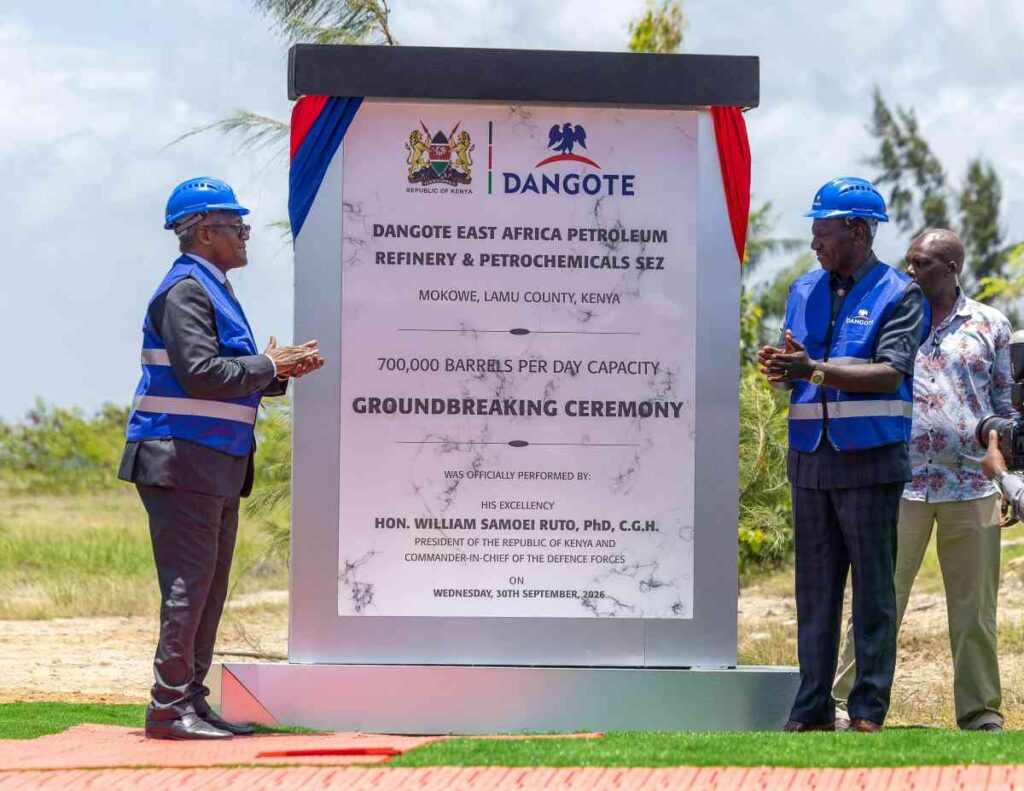
Nigerian industrialist Aliko Dangote and Kenyan President William Ruto have broken ground for a $16 billion oil refinery in Lamu, Kenya, as the Dangote Group expands its industrial investments across Africa and targets up to $50 billion in new capital spending through 2030.
The 700,000-barrel-per-day refinery is designed to supply petrol, diesel and jet fuel to Kenya and other markets in East Africa, reducing the region’s reliance on imported refined petroleum products.
The project is expected to be completed by 2030 and will include a 1,000-megawatt power plant. Dangote said the refinery is intended to serve a wider regional market, with countries including Uganda, Tanzania, South Sudan, Rwanda and the Democratic Republic of Congo among the potential markets.
Regional governments have been offered a combined 30% stake in the refinery, while the project is also expected to create tens of thousands of jobs during construction. The facility is being positioned as part of a broader industrial ecosystem around Lamu, with opportunities for logistics, engineering, manufacturing and other supporting businesses.
The Lamu refinery marks a significant expansion of Dangote’s refining strategy beyond Nigeria. The group’s Nigerian refinery in Lagos has a current crude-processing capacity of 700,000 barrels per day and is being expanded towards 1.4 million barrels per day.
Speaking at the groundbreaking ceremony, Dangote said the group plans to invest up to $50 billion across Africa by 2030, targeting sectors including mining, manufacturing, ports and energy. The investment programme follows about $25 billion spent by the group during the previous five-year period.
The new refinery also comes as East African countries seek to strengthen local and regional fuel supply. The project is expected to process crude from African producers and supply refined products closer to major consuming markets, potentially reducing the foreign exchange burden associated with importing fuel from outside the continent.
However, the project still faces a legal challenge in Kenya. A court has ordered the maintenance of the status quo over a land dispute involving residents, although Dangote has maintained that the groundbreaking would proceed and that the group would address the legal process.
For Dangote Group, the Kenya refinery represents more than an expansion of its petroleum business. It places the company’s growing industrial model directly into another major African market, with the group seeking to build businesses around the continent’s raw materials, energy resources and regional demand.