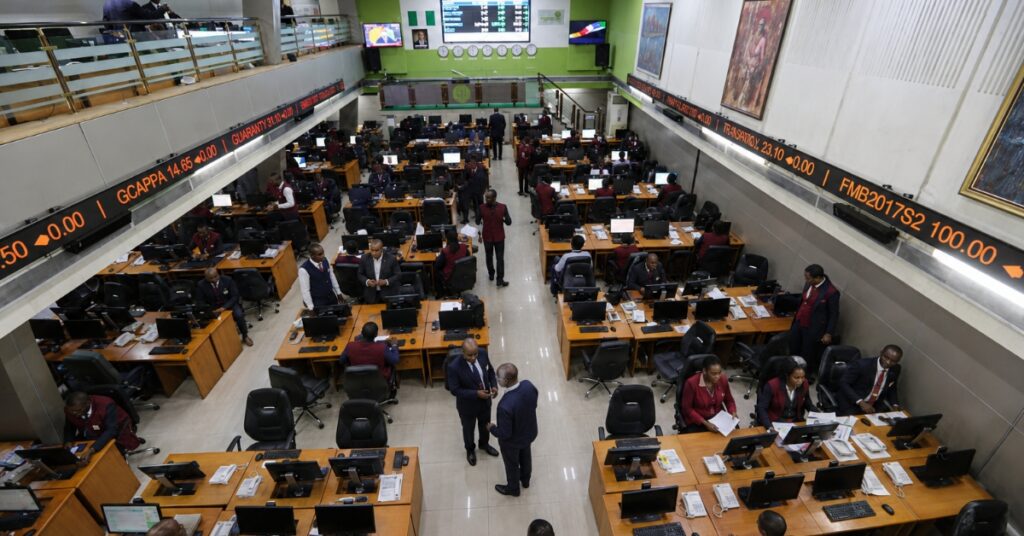
The Nigerian Exchange (NGX) recorded a fresh market capitalisation high of ₦164.91 trillion on Tuesday, October 27, after equities gained ₦1.75 trillion in a single session, although the rally was concentrated in selected stocks and trading activity was dominated by First HoldCo.
The NGX All-Share Index rose by 1.07 per cent to close at 253,990.06 points, up from 251,290.54 points on Monday. The gain lifted the market’s year-to-date return to 63.22 per cent, according to Proshare’s market report.
Dangote Cement was one of the main drivers of the session, with its share price climbing 9.8 per cent to close at ₦1,341.90. The stock’s advance helped lift the NGX Industrial Index by 5.5 per cent, making industrial shares the strongest-performing major sector during the session.
Other advancing stocks included Wema Bank, Access Holdings and Stanbic IBTC. However, the broader market picture was less uniform. Twenty stocks gained ground, while 36 declined, indicating that the increase in the headline index did not translate into gains for most listed companies.
Trading activity also surged, with approximately 5.23 billion shares exchanged in 35,882 deals. First HoldCo accounted for about 4.88 billion shares, representing more than 93 per cent of total volume, while its transactions contributed approximately ₦416.29 billion, or 94.3 per cent of the reported value traded.
The concentration is important when interpreting the market’s performance. Although the overall trading figures increased sharply, the unusually large First HoldCo transactions accounted for most of the activity. Excluding the company’s trades, the value of shares traded was about ₦25.15 billion, slightly below Monday’s level, according to Proshare’s calculations.
The rally also came amid differences in sector performance. The banking index was nearly flat, while the insurance index declined by 2.44 per cent. The gains in industrial shares therefore played a disproportionate role in lifting the overall market, rather than reflecting an across-the-board advance.
For investors, the new market record provides a reason to examine the companies driving the rally rather than relying solely on the headline index. Strong share-price gains can reflect improving business prospects, investor expectations or short-term trading demand, and those factors do not necessarily move together.
The next sessions will show whether buying interest spreads to more listed companies or remains concentrated in a smaller group of stocks. Investors will also be watching corporate earnings and other company disclosures to assess whether the market’s gains are supported by improvements in underlying business performance.